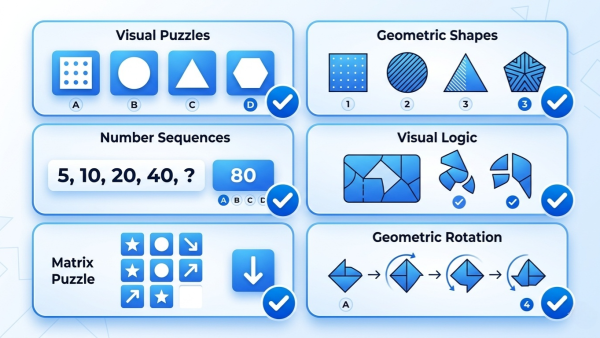
Once you’ve mastered beginner-level IQ questions, the next step is to challenge your thinking with more complex problems. Medium-level IQ questions are designed to push you beyond simple patterns and require multi-step reasoning, deeper analysis, and faster decision-making.
In this guide, you’ll explore a variety of medium-difficulty IQ practice questions, along with clear explanations to help you improve both accuracy and speed.
What Makes a Question “Medium-Level”?
Medium-level IQ questions are more challenging because they:
- Involve multiple rules or steps
- Require deeper pattern recognition
- Include less obvious relationships
- Demand stronger focus and attention to detail
Unlike easy questions, the answer is not immediately obvious—you need to analyze before solving.
Types of Medium-Level IQ Questions
1. Advanced Number Sequences
These sequences often combine multiple patterns such as:
- Alternating rules
- Increasing differences
- Mixed operations (addition + multiplication)
Example:
What comes next?
2, 6, 7, 21, 22, ?
Hint: Look for alternating patterns.
2. Complex Pattern Recognition
Instead of simple repetition, patterns may:
- Change direction
- Rotate
- Combine multiple transformations
Example:
A shape rotates 90° clockwise, then changes color every step. What comes next?
3. Multi-Step Logical Reasoning
These questions require combining multiple statements.
Example:
- All roses are flowers.
- Some flowers fade quickly.
- Are all roses guaranteed to fade quickly?
Hint: Pay attention to words like “some” vs “all.”
4. Verbal Reasoning with Nuance
More subtle relationships appear in medium-level analogies.
Example:
Teacher is to School as Doctor is to ______?
5. Spatial Reasoning
These test your ability to mentally manipulate shapes.
Example:
Which 3D shape is formed when a cube net is folded?
15 Medium-Level IQ Practice Questions
Now it’s time to challenge your thinking with medium-level IQ questions. These problems are more complex than beginner questions and often require multiple steps, deeper analysis, and careful attention to detail.
Before checking the answers, try to:
- Identify patterns or rules
- Break the problem into smaller parts
- Avoid guessing too quickly
Tip: Medium-level questions often combine two or more patterns, so look carefully.
Numerical Reasoning
These questions test your ability to detect multi-step numerical patterns.
1. What comes next?
2, 6, 7, 21, 22, ?
2. What comes next?
3, 9, 27, ?, 243
3. What comes next?
1, 4, 9, 16, ?
Strategy: Check for multiplication, addition, or alternating rules.
Logical Reasoning
These questions evaluate how well you interpret statements and draw conclusions.
4. All apples are fruits. Some fruits are yellow.
Are all apples yellow?
5. If no cats are dogs and some dogs are pets, can cats be pets?
Strategy: Pay attention to keywords like “all,” “some,” and “none.”
Verbal Reasoning
These test your ability to understand relationships between words.
7. Teacher is to School as Doctor is to ______?
8. Knife is to Cut as Pen is to ______?
Strategy: Identify the function or relationship in the first pair.
Pattern Recognition
These questions involve recognizing non-obvious sequences and structures.
9. What comes next?
A, C, E, G, ?
10. What comes next?
1, 1, 2, 2, 3, 3, ?
Strategy: Look for patterns in position, repetition, or increments.
Spatial / Visual Thinking
These questions test your ability to mentally manipulate shapes.
10. If a shape rotates 180°, what happens to its orientation?
11. Which shape is the mirror image of a given object? (visualize mentally)
Strategy: Try to imagine flipping or rotating the object in your mind.
Mixed Reasoning
These questions combine basic math, logic, and general knowledge.
12. What is half of 100 plus 20?
13. Which number is missing:
5, 10, ?, 20, 25
14. Which is heavier: 1 kg of iron or 1 kg of cotton?
15. If all squares are rectangles, are all rectangles squares?
Strategy: Stay calm—some questions are easier than they appear.
Answers and Explanations
Reviewing explanations is essential. Focus on understanding the logic, not just memorizing answers.
Numerical Answers
1. 66
→ This sequence follows an alternating pattern:
×3, +1, ×3, +1…
2×3=6 → +1=7 → ×3=21 → +1=22 → ×3=66
2. 81
→ Each number is multiplied by 3:
3 → 9 → 27 → 81 → 243
3. 25
→ These are perfect squares:
1², 2², 3², 4² → next is 5² = 25
Logical Answers
4. No
→ The statement says some fruits are yellow, not all.
Therefore, apples are not guaranteed to be yellow.
5. Yes
→ Cats are not dogs, but nothing prevents cats from being pets.
So it is possible.
Verbal Answers
6. Hospital
→ A teacher works in a school, just like a doctor works in a hospital.
7. Write
→ A knife is used to cut, a pen is used to write.
Pattern Answers
8. I
→ The letters increase by 2 steps in the alphabet:
A → C → E → G → I
9. 4
→ Each number appears twice:
1, 1 → 2, 2 → 3, 3 → 4
Spatial Answers
10. It flips upside down
→ A 180° rotation reverses the orientation completely.
11. Depends on the object
→ You must mentally reflect the shape across a mirror axis.
This requires visualization skills rather than a fixed rule.
Mixed Answers
12. 70
→ Half of 100 = 50 → plus 20 = 70
13. 15
→ The sequence increases by +5:
5 → 10 → 15 → 20 → 25
14. Equal
→ Both weigh exactly 1 kilogram, regardless of material.
15. No
→ All squares are rectangles, but not all rectangles are squares.
A square is a special type of rectangle.
How to Approach Medium-Level Questions
To succeed at this level:
1. Break Problems Into Steps
Don’t try to solve everything at once—analyze each part.
2. Look for Multiple Patterns
Many medium questions combine two rules.
3. Manage Your Time
Avoid spending too long on one question.
4. Stay Calm Under Pressure
Complexity can create stress—stay focused.
Common Mistakes at This Level
- Missing secondary patterns
- Rushing through logic
- Overthinking simple steps
- Ignoring small details
Who Should Practice Medium-Level Questions?
These questions are ideal for:
- Learners moving beyond beginner level
- Students preparing for aptitude tests
- Professionals improving analytical skills
Level Up Your Thinking
Medium-level IQ questions are where real improvement begins. They force your brain to:
- Think deeper
- Analyze faster
- Adapt to complexity
Keep Challenging Yourself
The more you practice, the better you become. Stay consistent, review your mistakes, and gradually move toward advanced-level challenges.
Your thinking skills will grow faster than you expect.