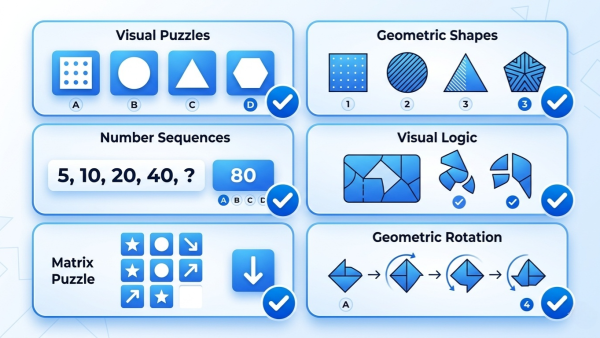
Many people use IQ-style practice questions to improve their thinking skills, but there is often confusion about how these exercises compare to a real IQ test.
Are practice questions the same as an official IQ test? Do they measure your intelligence accurately?
The short answer is no. While they may look similar, IQ practice and real IQ tests serve very different purposes.
In this guide, you’ll learn the key differences, what each is designed for, and how to use them effectively.
What Is an IQ Practice Test?
IQ practice questions are informal exercises designed to help you train cognitive skills and become familiar with common problem types.
They typically include:
- Pattern recognition
- Logical reasoning
- Numerical sequences
- Spatial visualization
- Verbal analysis
Purpose of Practice Questions
- Build problem-solving skills
- Improve speed and accuracy
- Learn common question formats
- Reduce test anxiety
Practice is about learning and improvement, not measurement.
What Is a Real IQ Test?
A real IQ test is a standardized psychological assessment designed to measure aspects of intelligence under controlled conditions.
These tests are:
- Scientifically developed
- Statistically validated
- Administered under strict guidelines
Purpose of Real IQ Tests
- Assess cognitive ability
- Compare performance to population norms
- Provide standardized scores
Real IQ tests are about measurement and evaluation.
Key Differences Between IQ Practice and Real IQ Tests
1. Purpose
- IQ Practice: Skill development and training
- Real IQ Test: Measurement of cognitive ability
2. Accuracy
- IQ Practice: Not designed to produce accurate IQ scores
- Real IQ Test: Designed to provide reliable, standardized results
3. Structure
- IQ Practice: Flexible format, varying difficulty
- Real IQ Test: Carefully structured and balanced sections
4. Scoring
- IQ Practice: Informal or no scoring system
- Real IQ Test: Standardized scoring based on statistical models
5. Environment
- IQ Practice: Casual, self-paced
- Real IQ Test: Controlled conditions, often timed
6. Scientific Validation
- IQ Practice: Educational tools, not scientifically validated for measurement
- Real IQ Test: Backed by psychological research and testing standards
Why Practice Still Matters
Even though practice questions don’t measure IQ, they are still highly valuable.
Benefits of IQ Practice
- Improves pattern recognition
- Builds logical thinking skills
- Increases problem-solving speed
- Enhances test familiarity
- Boosts confidence
Practice helps you perform better in tasks similar to what you train.
Can Practice Improve Your IQ Test Score?
Yes—but with an important distinction.
What Practice Improves:
- Familiarity with question types
- Speed and efficiency
- Confidence under pressure
What Practice Does Not Guarantee:
Significant change in core intelligence
This improvement is often called “test-specific performance gain.”
The Concept of “Learning the Test”
When you practice IQ-style questions, you learn:
- Common patterns
- Problem-solving strategies
- Efficient approaches
This can lead to better performance on similar tests, even if your underlying intelligence remains stable.
When Should You Use IQ Practice Questions?
IQ practice is useful when you want to:
- Prepare for aptitude or cognitive tests
- Improve analytical thinking
- Train your brain regularly
- Build confidence in problem-solving
When Should You Take a Real IQ Test?
A real IQ test may be appropriate if you:
- Need a formal assessment
- Are undergoing educational or psychological evaluation
- Want a standardized measure of cognitive ability
Common Misconceptions
“Practice Tests Give You Your Real IQ”
False. Practice questions are not designed to measure IQ accurately.
“More Practice Always Means Higher IQ”
Not necessarily. Practice improves performance, not always intelligence.
“IQ Is Fixed and Cannot Change”
Partially true. While core intelligence is relatively stable, skills and performance can improve with training.
How to Use Both Effectively
The best approach is to combine both tools appropriately:
Use Practice Questions to:
- Train specific skills
- Improve speed and accuracy
- Learn patterns
Use Real IQ Tests to:
- Measure ability
- Track standardized performance
A Smarter Approach to Cognitive Training
Instead of focusing only on scores, aim to:
- Develop strong reasoning skills
- Improve problem-solving ability
- Build consistent practice habits
These benefits extend beyond any single test.
Final Thoughts
IQ practice questions and real IQ tests may look similar, but they serve different roles.
- Practice builds skills
- Tests measure ability
Understanding this difference helps you set realistic expectations and use each tool effectively.
Start Practicing With Purpose
Use IQ practice questions to strengthen your thinking skills and improve your performance over time. With the right approach, you can make meaningful progress—regardless of how IQ is measured.