If you're new to IQ-style questions, the best place to begin is with simple, easy-to-understand problems. These beginner-level questions help you build confidence, recognize patterns, and develop core thinking skills without feeling overwhelmed.
This guide introduces you to easy IQ practice questions, explains how to approach them, and helps you build a strong foundation for more advanced challenges.
What Makes an IQ Question “Easy”?
Easy IQ questions are designed to:
- Use clear and simple patterns
- Require basic logic or reasoning
- Avoid overly complex or tricky rules
- Focus on one skill at a time
They are ideal for beginners because they emphasize understanding over difficulty.
Types of Easy IQ Questions You Should Start With
When you're just beginning, it's important to focus on simple and structured question types. These help you understand how IQ problems work without overwhelming you.
Each type below targets a specific cognitive skill and builds the foundation for more advanced problem-solving.
1. Number Sequences
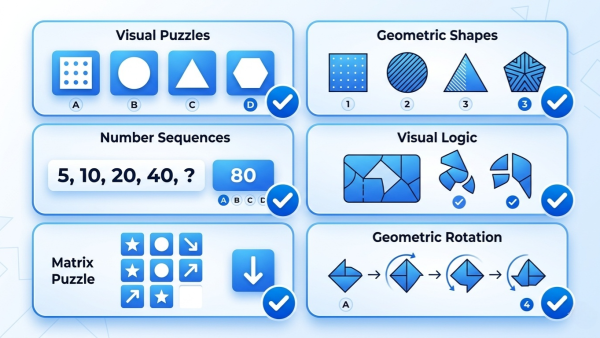
Number sequence questions train your ability to identify patterns, relationships, and rules within numbers. These are among the most common IQ question types and a great starting point for beginners.
You may encounter patterns such as:
- Simple addition or subtraction
- Multiplication or division
- Increasing differences (e.g., +2, +4, +6)
- Alternating sequences
Example:
What comes next?
2, 4, 6, 8, ?
Answer: 10
Explanation: The pattern increases by +2 each time. Once you recognize the rule, simply apply it to find the next number.
Beginner Tip: Always check the difference between numbers first—it’s often the simplest pattern.
2. Simple Pattern Recognition
These questions test your ability to identify repeating or changing patterns, often using shapes, letters or colors.
Patterns may involve:
- Alternating sequences
- Rotations or transformations
- Repeating cycles
Example:
A shape alternates: circle, square, circle, square, ?
Answer: Circle
Explanation: The sequence follows a repeating pattern of two elements: circle → square → repeat.
Beginner Tip: Look for repetition before assuming a complex rule.
3. Basic Logical Reasoning
Logical reasoning questions evaluate your ability to draw conclusions from given statements. These are often based on simple “if–then” relationships.
You’ll practice:
- Deductive reasoning
- Cause-and-effect thinking
- Understanding relationships between statements
Example:
- All cats are animals.
- All animals have legs.
- Do cats have legs?
Answer: Yes
Explanation: Since cats are animals and animals have legs, the conclusion logically follows.
Beginner Tip: Focus only on the information given—don’t assume anything extra.
4. Verbal Analogies
Verbal analogy questions test your ability to recognize relationships between words. This improves both logic and language skills.
Common relationships include:
- Opposites (hot → cold)
- Function (pen → write)
- Association (sun → day)
Example:
Sun is to Day as Moon is to ______?
Answer: Night
Explanation: The relationship is based on time of appearance—sun appears during the day, moon at night.
Beginner Tip: Identify the relationship in the first pair before answering.
5. Odd One Out
These questions require you to find the item that does not belong in a group. This tests classification and critical thinking.
You may need to identify:
- Category differences
- Functional differences
- Hidden patterns
Example:
Apple, Banana, Carrot, Orange
Answer: Carrot
Explanation: Carrot is a vegetable, while the others are fruits.
Beginner Tip: Group similar items first—then spot the one that breaks the pattern.
15 Easy IQ Practice Questions
Now it’s your turn to apply what you’ve learned. These beginner-friendly IQ questions are designed to help you practice core thinking skills step by step. Each category focuses on a different type of reasoning, so you can build a well-rounded foundation.
Take your time, think carefully, and try to identify the pattern or logic before looking at the answers.
Numerical Questions
These questions test your ability to recognize number patterns and sequences.
1. What comes next?
1, 3, 5, 7, ?
2. What comes next?
10, 20, 30, ?
3. What comes next?
5, 10, 15, ?
Tip: Look at how each number changes compared to the previous one.
Logical Questions
These questions evaluate your ability to draw conclusions based on given information.
4. If all dogs bark and Max is a dog, does Max bark?
5. If today is Monday, what day is tomorrow?
Tip: Focus only on the facts provided. Avoid overthinking.
Verbal Questions
These test your understanding of word relationships and meanings.
6. Bird is to Fly as Fish is to ______?
7. Big is to Small as Hot is to ______?
Tip: Identify the relationship in the first pair before completing the second.
Pattern Questions
These questions involve recognizing repeating or alternating patterns.
8. What comes next?
A, B, A, B, ?
9. What comes next?
Red, Blue, Red, Blue, ?
Tip: Check if the sequence repeats in cycles.
Odd One Out
Find the item that does not belong in the group.
10. Dog, Cat, Tiger, Table
11. Red, Green, Blue, Chair
Tip: Group similar items first, then find what breaks the pattern.
Mixed Easy Questions
These simple questions test general knowledge and basic reasoning.
12. What is 2 + 2?
13. Which is bigger: Elephant or Ant?
14. Which shape has 3 sides?
15. What comes after C in the alphabet?
Tip: Don’t overthink—these are designed to be straightforward.
Answers and Explanations
Understanding why an answer is correct is the key to improving your IQ skills. Review each explanation carefully.
Numerical Answers
1. 9 → The sequence increases by +2 each time (1, 3, 5, 7, 9)
2. 40 → The pattern increases by +10 (10, 20, 30, 40)
3. 20 → The pattern increases by +5 (5, 10, 15, 20)
Logical Answers
4. Yes → If all dogs bark and Max is a dog, then Max must bark. This is a direct logical conclusion.
5. Tuesday → Tuesday follows Monday in the weekly sequence.
Verbal Answers
6. Swim → Birds fly and fish swim. The relationship is based on movement or function.
7. Cold → Big and small are opposites, just like hot and cold.
Pattern Answers
8. A → The pattern repeats: A, B, A, B → next is A.
9. Red → The pattern alternates: Red, Blue → repeat → Red.
Odd One Out Answers
10. Table → Dog, cat, and tiger are animals. Table is not.
11. Chair → Red, green, and blue are colors. Chair is not.
Mixed Answers
12. 4 → Basic arithmetic: 2 + 2 = 4
13. Elephant → An elephant is significantly larger than an ant.
14. Triangle → A triangle is a shape with 3 sides.
15. D → D comes after C in the alphabet.
How to Practice Effectively as a Beginner
1. Focus on Understanding First
Don’t rush. Make sure you understand why an answer is correct.
2. Practice One Type at a Time
Start with number patterns, then move to logic, then verbal questions.
3. Keep Sessions Short
Practice for 10–20 minutes to avoid mental fatigue.
4. Repeat Similar Questions
Repetition helps your brain recognize patterns faster.
5. Track Your Progress
Notice which types you find easy or difficult.
Common Beginner Mistakes
Avoid these common issues:
- Guessing without thinking
- Ignoring simple patterns
- Overcomplicating easy questions
- Practicing too many types at once
- Not reviewing mistakes
Who Should Use Beginner IQ Questions?
These questions are perfect for:
- Students starting cognitive training
- Job seekers preparing for aptitude tests
- Anyone new to IQ-style questions
- Lifelong learners improving thinking skills
What Comes Next After Easy Questions?
Once you’re comfortable:
- Move to medium difficulty questions
- Practice timed sessions
- Combine multiple question types
- Focus on speed and accuracy
Build Confidence First, Then Complexity
Starting with easy IQ questions is the smartest way to begin your journey. It builds confidence, strengthens your thinking, and prepares you for more advanced challenges.
Start Practicing Today
Consistency is key. Even a few simple questions each day can significantly improve your reasoning skills over time.
Begin with easy questions, understand the patterns, and gradually challenge yourself—you’ll be surprised how quickly your thinking improves.